

Understanding The Landscape
First things first, let’s break down the key components of employer costs across these four dynamic markets:
Salary and Benefits
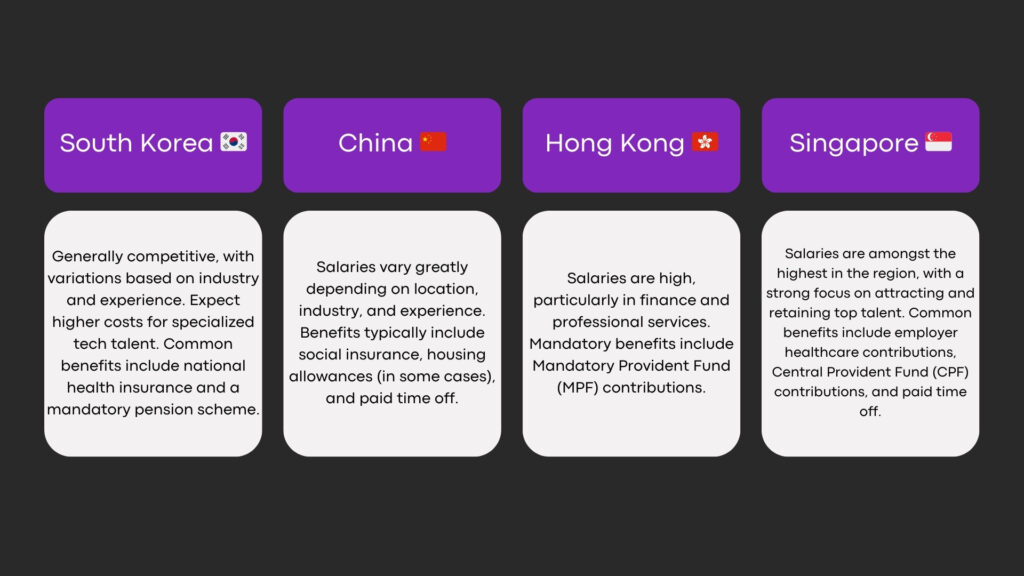
Payroll Taxes
Payroll taxes are mandatory contributions made by both employers and employees, typically used to fund social security benefits, healthcare systems, and unemployment insurance. These contributions vary significantly across East Asia, impacting your overall employer costs. Here’s a breakdown of the key payroll tax considerations for each country:
In South Korea, the Payroll taxes include the Workers’ Compensation Insurance, Resident Tax, Employment Insurance, Disable hiring fee, National health insurance, National pension and the Long-term Care Insurance.
As for China, which contains the higher employer costs, the payroll taxes for the city of Shanghai cover Work Injury Fund, Unemployment Fund, the most expensive one that is Pension Fund, Housing Fund, Maternity, Health Insurance and fund for the disabled. (Note: In China, every city has different Payroll Taxes, make sure to check websites like the National Administration of Human Resources and Social Security to equip yourself with the right information for the city you are looking for.)
Hong Kong is the country that covers the least Payroll Taxes for the reason that it only covers the Mandatory Provident Fund (MPF).
In Singapore, the Payroll Taxes cover the Skill Development Levy (SDL) and the Central Provident Fund (CPF).
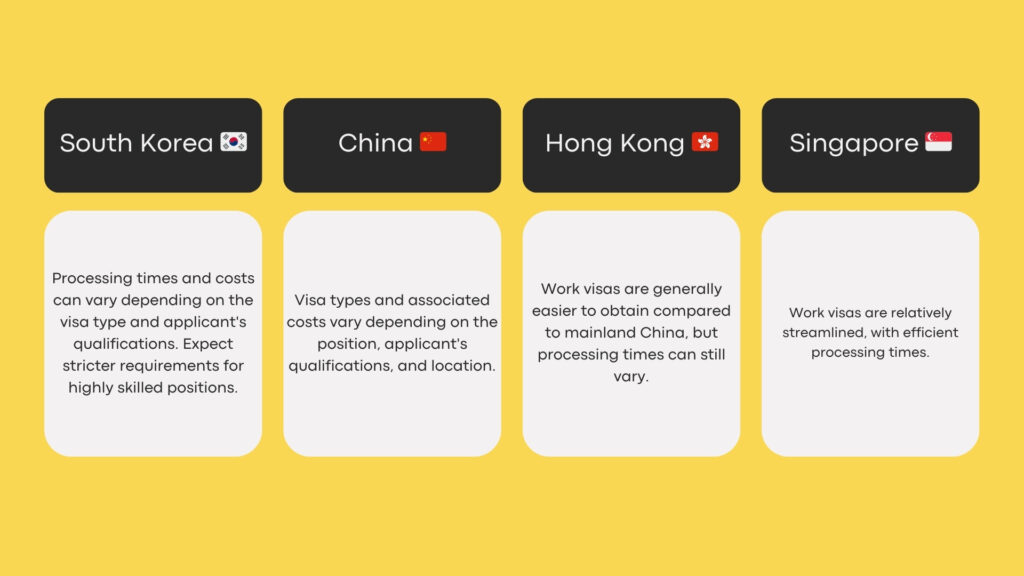
Work Visas and Permits
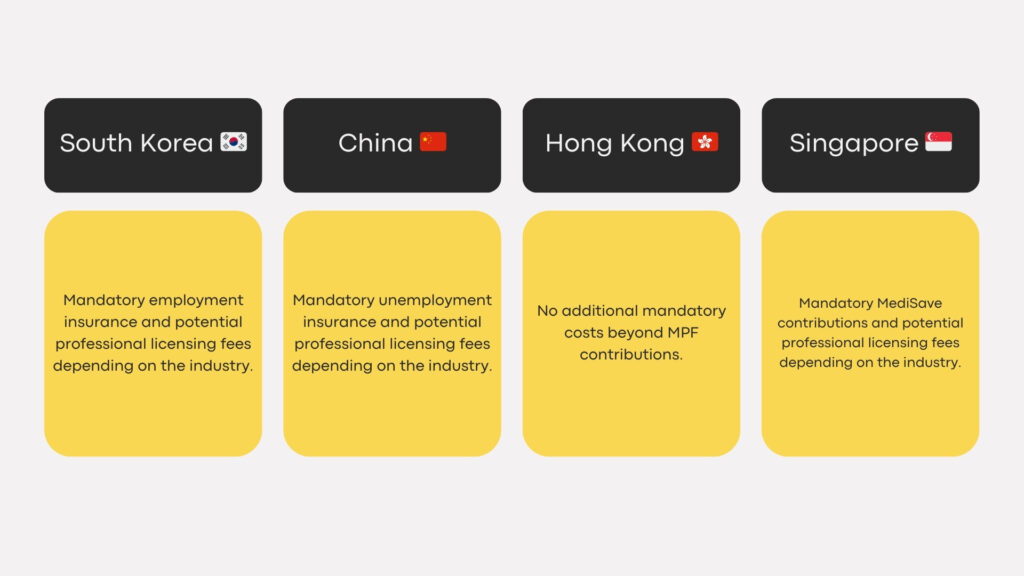
Additional Costs
Calculating Employer Costs: A Sample Scenario
To illustrate the impact of employer costs across these markets, let’s consider a hypothetical scenario: an annual salary of USD 100,000 for a tech talent hire. Here’s a breakdown of the estimated costs in each country:
South Korea: USD 100,000 (salary) + USD 9,240 (employer costs) = USD 109,240 (total cost)
China: USD 100,000 (salary) + USD 20,000 (employer costs) = USD 120,000 (total cost)
Hong Kong: USD 100,000 (salary) + USD 2,305 (employer costs) = USD 102,305 (total cost)
Singapore: USD 100,000 (salary) + USD 10,300 (employer costs) = USD 110,300 (total cost)
As you can see, the result can vary significantly depending on the location. While Hong Kong boasts the lowest in our example, other factors like talent availability, government incentives, and long-term cost benefits should also be considered when making strategic talent acquisition decisions.
Detailed Country Analysis
South Korea (USD 109,240): Employer costs fall close to Hong Kong’s, but stricter visa requirements and a mandatory pension scheme can add some complexity. Government incentives for foreign investment in specific industries can help offset these costs.
China (USD 120,000): The costs in China are the highest in our example. Significant variations exist depending on location, with social security contributions and regional minimum wage variations playing a role. However, China’s vast and diverse talent pool can be a major advantage, especially for companies seeking a large domestic market.
Hong Kong (USD 102,305): Offers the most attractive package due to minimal mandatory contributions beyond the Mandatory Provident Fund (MPF). This can be a major advantage for companies seeking to optimize their bottom line.
Singapore (USD 110,300): Employer costs here are slightly higher than Hong Kong but still competitive. Singapore boasts a streamlined work visa system and a highly skilled talent pool, making it an attractive option.
Choosing the Right Location
The most suitable location depends on your specific needs. Here’s a quick breakdown to help you decide:
Focus on Cost-Effectiveness: Hong Kong emerges as the winner for pure cost savings.
Prioritize Talent Pool and Efficiency: Singapore offers a balance between cost, talent availability, and a user-friendly work visa system.
Target the Chinese Market: China’s vast talent pool is unmatched, but be prepared for cost variations and potentially more complex regulations.
Seek Government Incentives: South Korea offers competitive costs with the potential for additional benefits through government programs in specific industries.
East Asia offers a wealth of opportunities for expanding businesses. By understanding and strategically navigating employer costs, you can make informed decisions that unlock the full potential of your talent pool in this dynamic region.
Frequently Asked Questions
Contact Agile HRO today to get help navigating the complexities of international employment. Our experts can help you identify the most suitable location for your talent needs, ensuring a smooth relocation process and minimizing employer costs.
Get Started with Agile
Schedule a 30-minute product demo with Q&A